
Fast & tracked delivery
Your dose of creativity arrives quickly at your home, you can track your package right to your mailbox.

🎯 Key takeaways:
🎨 When starting watercolor, one question always comes up: which brush to choose?
You don't need a complete arsenal to get started. A few carefully chosen brushes are enough.
In this guide, we will help you choose the right brush according to your level, use, and budget, without unnecessary purchases or headaches.
You will find a clear comparison of shapes, sizes, and bristle types, concrete recommendations, as well as "minimum" and "ideal" configurations to start serenely... and make your brushes last thanks to good maintenance habits.
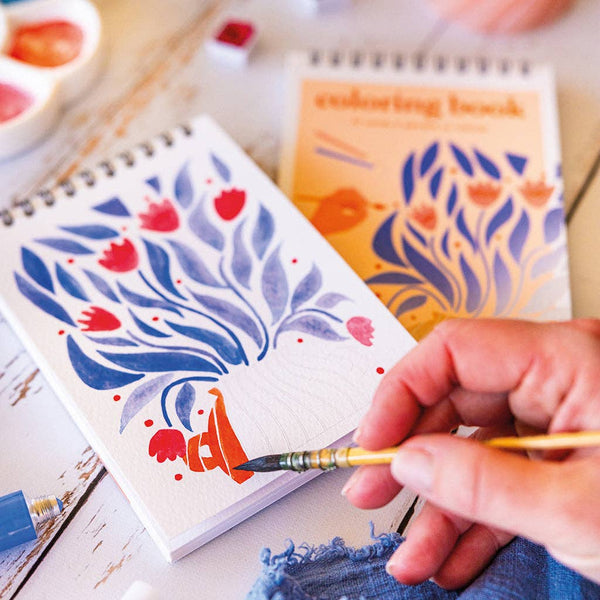
🎨 Ready to start watercolor?
Discover our notebooks for stress-free painting: travel formats, thick paper, easy ideas... Everything you need to get started simply and practice ✨
🌈 A small step today... and a lot of pleasure tomorrow.
Even before talking about brand or price, a good watercolor brush is recognized by a few criteria.
🖌️ Contrary to popular belief, a larger brush is not less precise.
A good medium-sized round brush (8–10) maintains a fine point once wet.
Result: you create washes without streaks, then details without changing brushes.
If the tip flattens or spreads too quickly, control becomes difficult.
💧 The "belly" of the brush is its ability to retain water and color.
The better the reservoir, the more fluid the stroke.
Why it makes a difference:
🎯 Each painter has a different feel.
Synthetic brushes are often snappier. Natural bristles are softer and more fluid.
🔍 These details are often overlooked... yet essential.
To check: the ferrule (metal part) must be tight, without play, no bristles should escape at the base, the handle must be smooth, without cracks, well balanced in the hand.
⚡ Quick test in store or upon receipt
When talking about watercolor brushes, a few shapes always come up.
You don't need to know all of them to get started. Here's the essential, with what they're really for.
🧭 Main shapes at a glance
🖌️ Pointed round
Versatile: washes + details.
The #1 choice for beginners.
📐 Flat
Backgrounds, bands, sharp shapes.
Useful but not essential.
💧 Wash / Mop
Large washes, skies, gradients.
For water lovers.
🖌️ This is the brush to recommend.
If you only had to choose one, this would be it.
It is well suited for beginners because it allows for washes, to draw fine lines and to add details, thanks to its point.
A good medium-sized round brush can cover 80% of watercolor uses.
It is the most versatile, the most reassuring... and the most used.
📐 The flat brush is very useful in specific cases.
It is mainly used for:
It becomes interesting when you like structured compositions or well-defined backgrounds.
💧 This brush is recognizable by its round and very full shape.
It is designed to hold a lot of water.
Typical case:
These brushes often come in squirrel hair or imitation squirrel hair, known for their enormous water retention. They offer a very fluid stroke, ideal for generous washes.
🌿 These brushes are interesting... but not essential at the beginning.
They are used for specific purposes:
Save them for later, when you want to explore specific effects.
Psss... to find out everything about how to start watercolor, it's here!

This is one of the questions when looking for which watercolor brush.
🧭 Which brush is right for you?
🎯 I want to control my stroke
Choose a snappy synthetic brush
or an imitation sable for more precision.
💧 I love washes and water
Opt for a mop brush
or an imitation squirrel hair with a large reservoir.
✨ I want a beautiful, durable brush
Invest in a Kolinsky sable brush,
pleasant and durable over time.
🖌️ Kolinsky sable brushes are often considered the top-of-the-line for watercolor.
They are known for: an extremely precise point, excellent snap (the brush returns well to its place), a long lifespan if well maintained, good water retention, without excess.
It's a real painting pleasure... but also an investment.
They are especially interesting if you paint regularly and already know what you like.
👉 Models like Raphael 8404 or Winsor & Newton Series 7 are often cited together in user discussions as quality references.
💧 The squirrel brush is the opposite of sable.
Its strengths:
It's perfect for: skies, backgrounds, very wet gradients, broad strokes.
However, it is less precise for details.
It is a brush for feeling and movement, rather than control.
💡 Modern synthetic brushes have progressed enormously.
They are often the best choice for beginners.
Two families often come up in discussions:
These differences explain why two synthetic brushes can give very different sensations.

If you hesitate between several sizes, rest assured: it's normal.
🖌️ Many beginners choose a brush that is too small.
The result: the paint dries too quickly, leaves marks, and you go over it again... which creates even more marks.
A slightly larger brush: holds more water, makes strokes more fluid, facilitates gradients, and avoids frustration from the first session.
🎯 If you want to keep it simple, here's the duo that works almost every time:
With these two, you cover most needs, without getting scattered.
Two brushes from the same range can give very different feelings depending on the shape, fiber, and your stroke. The goal here is to give you reliable benchmarks.
💡 Tip: if your budget is limited, first invest in a round pointed brush (the most used).
🎯 For whom? Beginners, parents, teachers, occasional practice.
Recommended sizes to start
🌿 For whom? Motivated beginners, regular amateurs.
The Princeton Neptune range is often appreciated for:
Note: feedback varies depending on the point and size.
Some prefer these brushes for washes, others for medium to large formats. To be tested according to your style.
✨ For whom? Regular practice, seeking precision and durability.
Kolinsky sable brushes are often cited for their: very fine point, excellent spring, balanced water retention, longevity.
The Raphaël 8404 regularly comes up in discussions for its point/reservoir balance, often compared to the Winsor & Newton Series 7.
These are beautiful tools, designed to last… if properly maintained.
A good brush can last for years… provided you adopt a few habits.
🖌️ These steps are enough to preserve your watercolor brushes:
🚫 Some very common habits damage brushes:

Laetitia Jandric
Founder of JOY! · Creative Leisure Expert
A mother of three and founder of JOY! since 2022, Laetitia selects and tests each creative kit before listing it. Her articles combine practical advice, field experience feedback, and concrete recommendations to help everyone find the activity or gift that truly fits.
Learn more →
Your dose of creativity arrives quickly at your home, you can track your package right to your mailbox.

Got a problem? Don't panic, you have 15 days to change your mind.
Creative activities for young and old (from 0 to 77 years old!), perfect for disconnecting from screens and spending real time together.

JOY! is fun, colorful, and a touch of madness to dust off your creative leisure activities!